1. What a Timegrapher Measures
A timegrapher listens to the escapement and times its sounds. From those times it works out how fast the watch runs, how far the balance swings, and how evenly the two halves of each swing are timed.
It can’t see the balance, feel the mainspring or look at a tooth. Knowing which sound each number comes from tells you when to trust a number, and when the microphone, not the watch, has changed.
This guide covers the Swiss lever escapement only.
The Beat
- The balance and hairspring swing to and fro. One swing from one end to the other is a beat (or vibration). Two beats make one full oscillation.
- A 4 Hz (hertz: full oscillations a second) balance makes 8 beats a second: 28,800 beats per hour (bph).
- Near the middle of each swing, the impulse pin enters the pallet fork. The balance unlocks the escapement, and the escape wheel gives the balance a push (the impulse) to keep it going.
- The next beat does the same the other way, on the other pallet stone.
The app calls the two kinds of beat Tick (blue) and Tock (orange).
- They alternate: every second beat is a Tick.
- These are the app’s labels, given when a take starts. They don’t say which pallet stone is which.
- When the two sides sound too alike to tell apart after a gap in the sound, the app keeps the names by counting beats, and says so.
The Three Sounds of a Beat
Each tick is really three sounds close together:
| Sound | What happens | Why it matters |
|---|---|---|
| Unlock | The impulse pin strikes the fork and starts to move the lever. The pallet stone slides off the escape-wheel tooth. | The start of the lift. Amplitude and beat error are timed from here. |
| Impulse | The escape-wheel tooth pushes on the pallet stone’s impulse face, and the fork pushes the balance. | Usually the quietest. It sits between the other two. |
| Drop | The escape wheel turns freely, then a tooth lands on the other pallet stone, and the lever reaches its banking. | Usually the loudest. The end of the lift. |
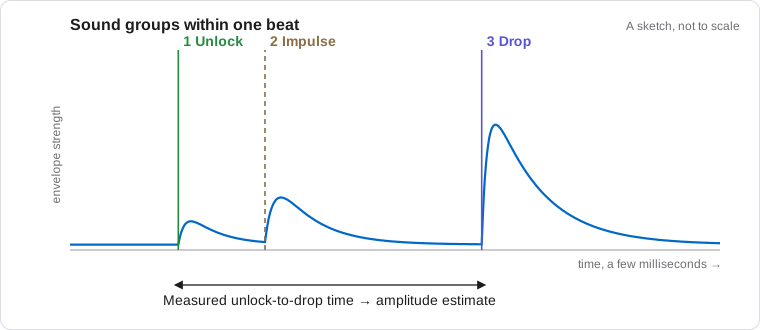
- Strictly, drop is the escape wheel’s free turn. The microphone hears the knock at its end.
- The three sounds don’t always show as three clean peaks. The case, the holder and the microphone change how loud each one sounds.
Sources:
- Witschi, Measuring Technology and Troubleshooting for Watches, training course PDF, on the sound groups.
- Horopedia, Swiss lever escapement, sections 6 and 9, on the mechanical sequence.
The Four Things It Measures
Beat Rate
What it is: how many beats an hour the movement is made to make, such as 28,800 bph.
| Balance | Beat rate | Time between beats (ms: milliseconds) |
|---|---|---|
| 2.5 Hz | 18,000 bph | 200 ms |
| 3 Hz | 21,600 bph | 166.7 ms |
| 4 Hz | 28,800 bph | 125 ms |
| 5 Hz | 36,000 bph | 100 ms |
Why it matters: every other reading is worked out against it. A steady strip at the wrong beat rate gives wrong readings.
Rate
What it is: how many seconds a day the watch would gain or lose if it kept running exactly as it is now. +10 s/d (seconds a day) gains, −10 s/d loses.
Why it matters: it is what the owner notices on the wrist. It changes with position, wind and temperature, so one reading describes one moment, not the watch.
How it is heard: at 28,800 bph, +10 s/d makes each beat come about 14.5 microseconds sooner after the last, so the beats drift steadily ahead of a perfect clock. The app fits a line through many beat times rather than timing one beat.
The sound card’s clock: the microphone’s sound card keeps its own time, and it is rarely exact. A card 20 parts per million off moves every rate by about 1.7 s/d. The app corrects for this where it can.
Amplitude
What it is: how far the balance turns from rest to the end of its swing, in degrees. At 270°, the balance travels about 540° from one end to the other.
Why it matters: it shows how much energy reaches the balance. It changes with wind, position, lubrication and wear.
How it is heard: the time from unlock to drop is the balance passing through the lift angle, a small arc set by the movement’s design. A balance swinging wider passes through that arc faster.
What it needs: the right lift angle. Every amplitude is in proportion to it, so 52° instead of 55° reads about 5% low. The lift angle comes from the calibre; with none set, the app uses 52° and says so.
Beat Error
What it is: how unevenly the Tick and Tock halves of the swing are timed. If one half takes 124.7 ms and the next 125.3 ms, the beat error is half the difference, 0.30 ms.
Why it matters: it shows whether the balance’s rest point sits centred in the escapement.
How it is heard: from the unlock of each beat. The Beat Error card’s hover also gives a figure timed from the drop. When the two differ, the sound of the two sides differs; that alone says nothing about the escapement.
Its sign: the cards show the size only, because which side is “Tick” is the app’s label, not the watch’s.
Precision Is Not Accuracy
Three different things:
- Precision: how much the reading scatters. The ± beside each figure estimates this.
- Steadiness: how much the watch itself changes over time. The Steadiness panes look at this.
- Accuracy: how close the figure is to the truth. A wrong lift angle or an uncorrected sound card clock can give a precise reading that is wrong.
A small ± doesn’t mean the setting behind a reading is right, or that the next take will read the same.
Next: Your First Take
This page comes from the app's user guide at v1.0.1. See it on GitHub.